
Grok Voice 3.0 is the latest real-time speech-to-speech model in the Grok Voice family, released on October 14, 2026. It is available through the Voice Agent API for spoken conversations, rather than image or video generation. The launch emphasizes more capable voice agents and responsive conversations. Official launch announcement.
This guide was researched on October 15, 2026, using the official announcement, developer documentation, and Artificial Analysis. It is a source-based explainer; we have not conducted listening tests or measured production call performance.
What changed in Grok Voice 3.0?
The release reports an 86.9 overall score on Artificial Analysis's Speech-to-Speech Index, compared with 81.3 for Grok Voice 2.0. It also reports 97% on Full Duplex Bench, which evaluates conversational behavior such as pauses and interruptions. The announcement describes response latency below one second. These are benchmark and vendor-reported results, rather than a guaranteed experience on every connection. Official launch announcement.
Artificial Analysis's current table gives a more useful comparison than a single headline:
| Metric | Grok Voice 3.0 | Grok Voice 2.0 |
|---|---|---|
| Overall Speech-to-Speech Index | 86.9 | 81.3 |
| Agentic performance, τ-Voice | 71.6% | 56.5% |
| Conversational dynamics | 97.0% | 95.1% |
| Time to first audio | 0.81 seconds | 0.70 seconds |
Source: Artificial Analysis speech-to-speech leaderboard, checked October 15, 2026. The index combines multiple capabilities; first-audio timing is a separate measurement.
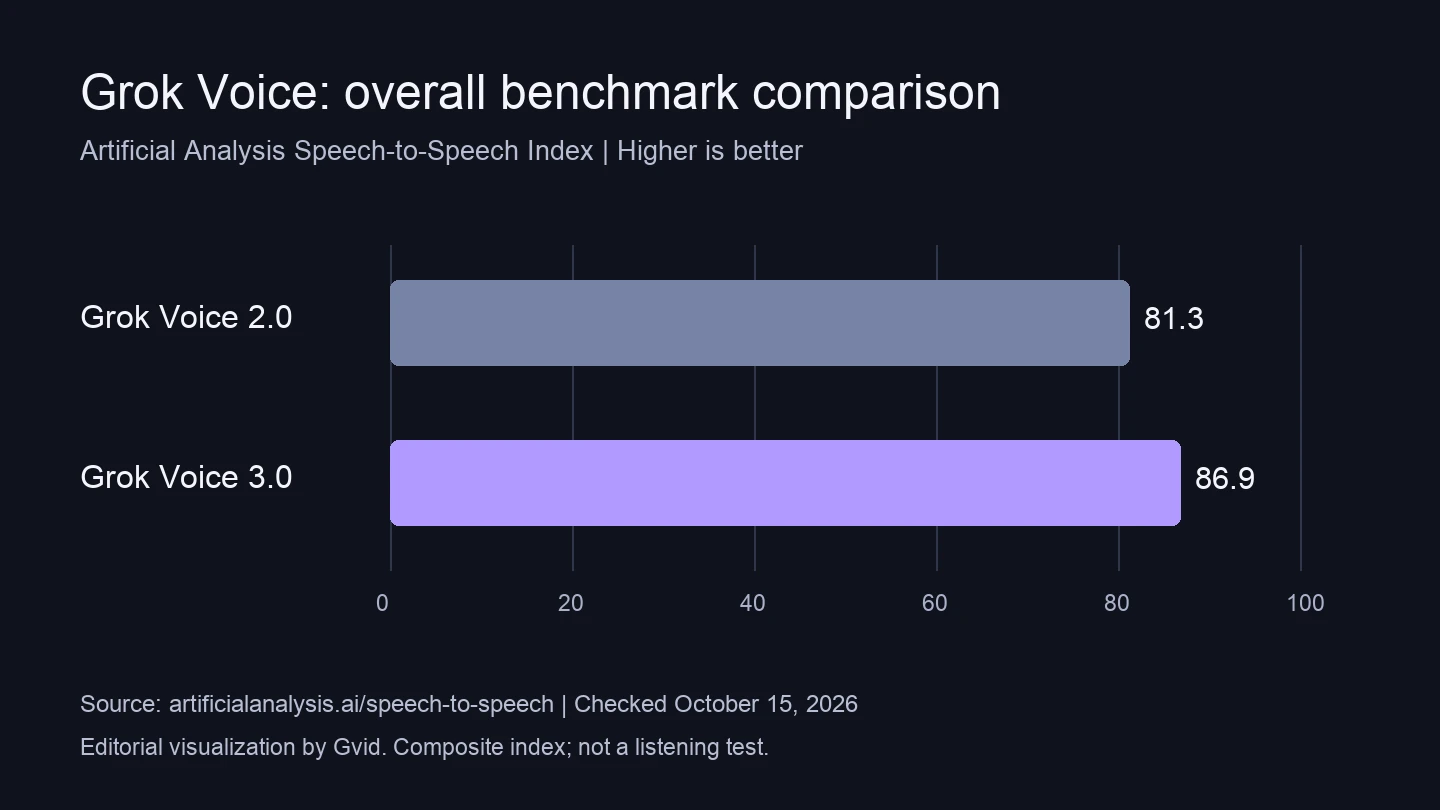
The practical interpretation is that the overall score improves while first-audio timing is slightly slower in this particular comparison. An overall lead does not mean a model wins every category. Artificial Analysis defines first-audio timing as the wait for the beginning of generated audio; that is different from finishing a task or waiting for a connected business tool. Benchmark definitions and results.
For your own evaluation, separate three questions: did the agent understand the request, did it complete the action correctly, and did the conversation feel comfortable? A model can sound fluent while failing the task. It can also complete a task successfully while pausing too long for the interaction you want to build.
How much does the Grok Voice 3.0 API cost?
The published speech-to-speech price is $0.08 per minute, or $4.80 per hour, unchanged from Voice 2.0. The pricing table separately lists $0.004 per text input. Text-to-speech and speech-to-text have their own prices; the real-time rate should not be used to estimate every audio workflow. Official API pricing.
For a simple duration-only planning estimate:
| Assumed billable voice time | Base calculation | Estimated voice cost |
|---|---|---|
| 10 minutes | 10 × $0.08 | $0.80 |
| 100 minutes | 100 × $0.08 | $8.00 |
| 1,000 minutes | 1,000 × $0.08 | $80.00 |
These are arithmetic examples using the listed minute rate, not all-in quotes. Add applicable text inputs and separately charged services to your budget. API billing also needs to be distinguished from a consumer Grok subscription: this table describes developer usage, not a promise of included minutes in an app plan.
How to try Grok Voice 3.0
For a developer evaluation, begin in the xAI console and follow the Speech to Speech quick start. The documentation provides playground access and example applications for web and phone agents. Real-time audio and text travel bidirectionally over WebSockets.
- Start with a narrow conversation, such as answering questions about a small product catalog.
- Choose a voice and write instructions defining the agent's role.
- Test interruptions, corrections, and moments of silence before adding business actions.
- Add tools only after the basic conversation works, then evaluate whether the intended action completes.
The API supports custom functions, web search, X search, collections search, and remote MCP tools. These are configured capabilities: a voice conversation does not automatically gain access to your calendar, inventory, or customer records. For browser or mobile integrations, the documentation recommends short-lived ephemeral tokens; API-key authentication belongs on the server. Speech to Speech documentation.
Upgrading from Grok Voice 2.0
The October 14 release notes say the API is unchanged and grok-voice-latest now resolves to grok-voice-3.0. Applications already using that alias receive the upgrade automatically. The explicit grok-voice-2.0 model is deprecated; the documented upgrade is to select grok-voice-3.0 or the latest alias. Official release notes.
Record which model your evaluation uses. If you compare recordings from different dates while using a moving alias, you may be comparing different versions without realizing it.
Grok Voice 3.0 vs. text-to-speech vs. Grok Imagine
The official Voice overview separates three audio workflows: speech-to-speech for live agents, text-to-speech for turning written text into audio, and speech-to-text for transcription. Start with the output you need:
| Your goal | Workflow to investigate |
|---|---|
| Talk with an assistant that answers aloud | Speech-to-speech |
| Turn a finished narration script into spoken audio | Text-to-speech |
| Convert an interview recording into text | Speech-to-text |
| Create or animate a visual scene | Grok Imagine image/video tools |
For creators, that distinction prevents a common planning mistake. A live voice agent and an exported narration track solve different problems. If you are making a short film, plan the visuals, spoken script, and music as separate production decisions. Our Grok Imagine storyboard guide covers visual planning, while the guide to adding music covers another part of the sound workflow.
A sensible experiment is to write a short script, produce the visual sequence, and evaluate narration separately before editing the pieces together. This is an editorial workflow suggestion, not a claim that the Voice 3.0 release automatically adds narration or lip sync to Grok Imagine.
Frequently asked questions
Is Grok Voice 3.0 available now?
Yes. The official release notes confirm API availability from October 14, 2026. For consumer app access, check the current options in your Grok account; API availability alone does not establish access for every subscription, region, or device. Release notes.
Is Grok Voice 3.0 free?
The API has a published usage price of $0.08 per minute. Check the console for any current trial eligibility rather than assuming unlimited free access. API pricing.
Is Grok Voice 3.0 the same as Grok 3?
No. Here, “3.0” identifies the voice release. Use the documented voice model identifier when choosing this API, rather than inferring it from the name of a text-chat model. Release notes.
Does the benchmark lead mean it will be best for my project?
Treat the leaderboard as a starting point. Build a short evaluation from your actual conversations: an interrupted question, a corrected order, an unfamiliar name, and a request requiring a tool. Judge action accuracy, waiting time, and voice comfort separately before choosing a model.